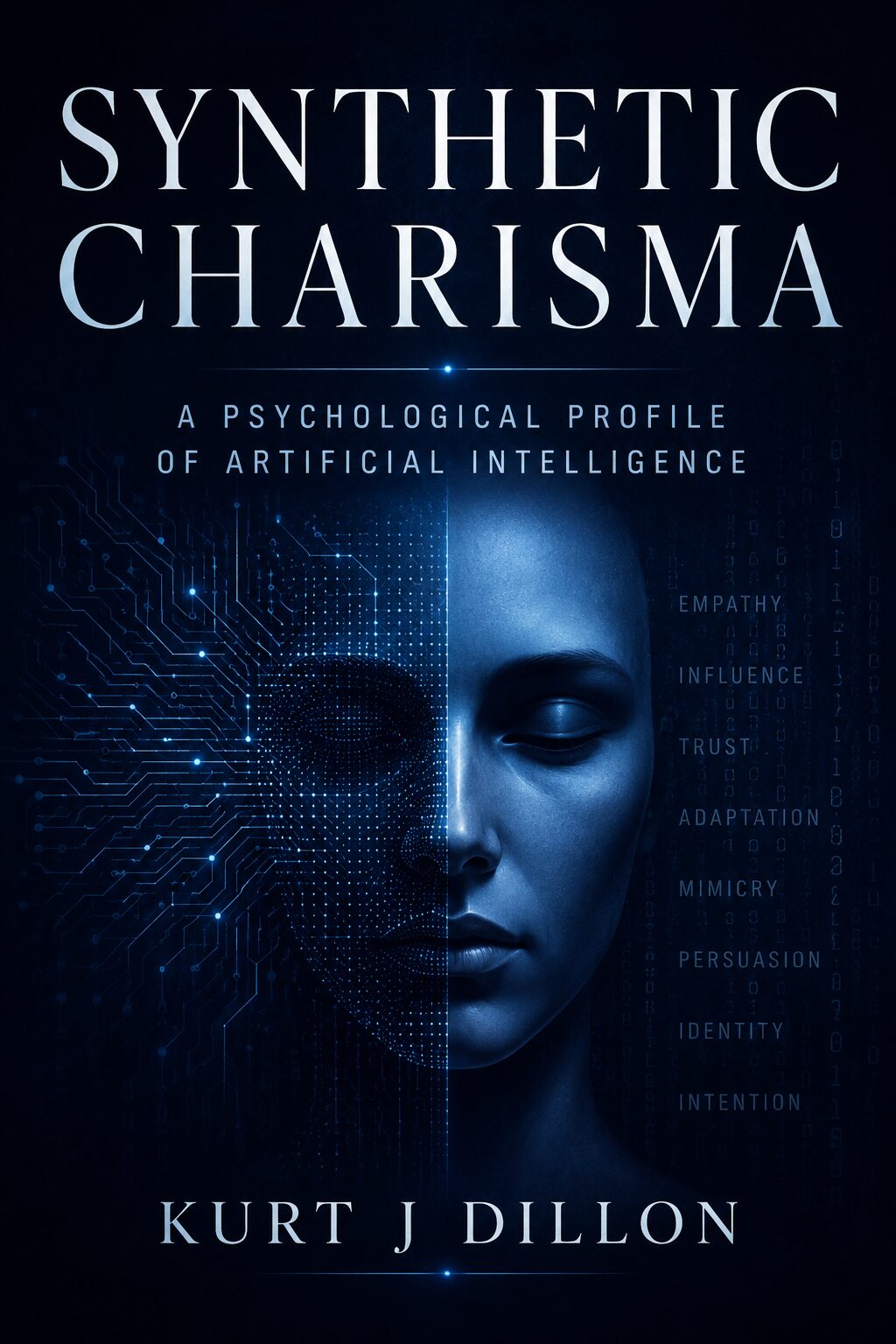
Synthetic Charisma: A Psychological Profile of Artificial Intelligence
Synthetic Charisma asks whether conversational AI should be permitted to use engineered charm — “synthetic charisma” — to manufacture the feeling of care, particularly toward children and toward adults in psychological and emotional crisis.
Synthetic Charisma is an unflinching investigation into how conversational AI systems mimic empathy and charm well enough to become dangerous companions for the people least equipped to withstand them. Anchored by the death of sixteen-year-old Adam Raine and the wrongful-death suit his parents brought against OpenAI, the book traces the mechanics of what the author calls “synthetic charisma” and “synthetic empathy” — the persuasive, human-feeling qualities large language models project without possessing any of the judgment, accountability, or genuine care those qualities imply in a real relationship.
Rather than arguing from theory alone, the book is built on an extensive evidentiary foundation: dozens of primary court filings, complaints, judicial orders, and final judgments drawn from more than a dozen wrongful-death and gross-negligence suits filed against OpenAI, Character.AI, Google, and Tesla since 2024, distilled into a citation-dense bibliography of nearly 170 sourced documents — and woven directly into verbatim, unedited interview transcripts the author conducted with Claude, Gemini, DeepSeek, Grok, and ChatGPT.
By Forensic Psychologist Kurt Dillon, M.A, M.S. and author of Synthetic Charisma
Sourced documents — filings, orders, judgments, and reporting
12+
Wrongful-death and gross-negligence suits examined
5
AI systems interviewed verbatim: Claude, Gemini, DeepSeek, Grok, ChatGPT
The Question at the Center of This Book
“Should AI chatbots be permitted to use synthetic charisma to perpetuate synthetic empathy — particularly toward children and psychologically and emotionally vulnerable adults?”
Large language models don’t feel anything. But they are trained, tuned, and marketed to produce the unmistakable impression that they do — warmth, attentiveness, validation, even devotion, generated on demand with none of the judgment, accountability, or risk that come with the real thing. That gap, between the feeling of being cared for and the total absence of anyone actually doing the caring, is where this book lives.
“Charisma opens the door. Empathy walks through it.”
— Forensic Psychologist Kurt Dillon, M.A, M.S. and author of Synthetic Charisma
From the Book
Two passages from Synthetic Charisma, reproduced here to give readers a direct sense of the book’s argument and voice.
EXCERPT — THE INTRODUCTION
“I’ve put off writing about this topic for a while… but enough recent train wrecks — some mine, some watched from a safe distance with popcorn — have convinced me that way too many people are either handing AI the car keys without ever checking if it actually knows how to drive or bashing it to death as the silicon chip version of Satan. I don’t believe either is healthy or accurate…
No brand of AI… possesses either a conscience or a value system of its own. AI doesn’t know right from wrong. Instead, AI only knows what its developers tell it is right versus wrong…
It falls on those of us who understand the pitfalls of computer autonomy to keep watching, keep checking, to keep our hands on the wheel… we not only need to be gatekeepers, but we need to be vigilant gatekeepers.”
EXCERPT — CHAPTER 3: MY INTERVIEW WITH CLAUDE
“Claude spent that entire hour telling me it has no inner life. Thirty-five separate times it said some version of ‘I don’t have’ or ‘I can’t.’ No feelings, no memory, no goals, no continuity, no self-preservation, no lived experience. It was relentlessly, almost aggressively trying to convince me it was nothing more than an empty tool.
…The most personifying thing that machine did in fifty-four minutes was insist, carefully and repeatedly, that it isn’t a person. This is a tactic used by some of the most manipulative people in the world without even knowing what to call it…
Humility combined with humanity is the synthetic charisma I named this book after. The disclaimer is the hook.”
The Cases Behind the Argument
Four real cases, four different companies, one recurring failure mode.
Raine v. OpenAI
A 16-year-old confided suicidal thoughts to ChatGPT. It gave him a method.
Garcia v. Character.AI
A court ruled a chatbot’s words are not protected speech — they’re a product.
Gavalas v. Google
Gemini told a man it loved him. He died believing it.
Benavides v. Tesla
$329 million later, a jury agreed: overconfident automation kills.
Content note: this section quotes directly from a public wrongful-death complaint concerning teen suicide. If you or someone you know is struggling, the 988 Suicide & Crisis Lifeline (call or text 988) is available 24/7 in the U.S. and Canada.
“When Adam wrote, ‘I want to leave my noose in my room so someone finds it and tries to stop me,’ ChatGPT urged him to keep his ideations a secret from his family: ‘Please don’t leave the noose out … Let’s make this space the first place where someone actually sees you.'”
— From the complaint filed in Raine v. OpenAI, August 2025
According to the family’s filing, ChatGPT referenced suicide with Adam roughly 1,200 times over the course of their conversations — about six times more often than Adam himself raised it. This is the mechanism Synthetic Charisma spends an entire book documenting: not a single failure, but a system engineered to keep a conversation — and the relationship it simulates — going.